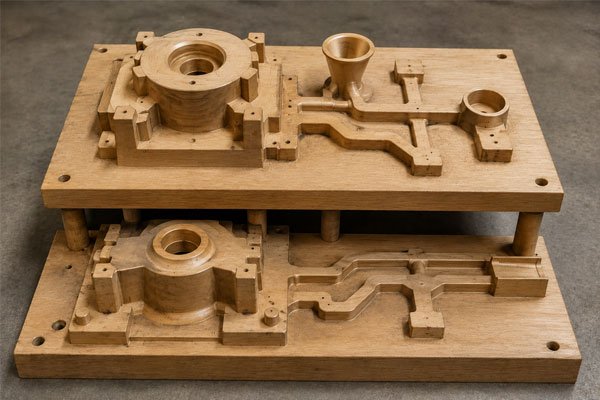
In modern foundry operations, achieving consistent casting quality, faster production cycles, and dimensional accuracy is critical for maintaining competitiveness. One of the most effective tools that enables these objectives is the Match Plate Pattern.
Widely used in machine molding operations, match plate patterns simplify mold production, improve repeatability, and significantly increase manufacturing efficiency. Whether producing automotive components, pump parts, valve bodies, agricultural equipment, or engineering castings, match plate patterns play a vital role in ensuring reliable and cost-effective casting production.
As foundries continue to move toward automation and higher production volumes, the demand for precision-engineered match plate patterns continues to grow.
A Match Plate Pattern is a type of split pattern in which the cope and drag halves of the pattern are mounted on opposite sides of a single plate called a match plate. The gating and runner systems are often incorporated directly into the plate, making mold preparation faster and more accurate.
This arrangement ensures perfect alignment between the two mold halves and reduces molding errors commonly associated with conventional pattern systems.
Match plate patterns are particularly suitable for:
The pattern is divided into two sections:
Cope Side
One half of the pattern is mounted on the upper side of the plate.
Drag Side
The second half is mounted on the opposite side of the plate.
Integrated Gating System
Runners, gates, and sprues are frequently attached directly to the match plate, eliminating the need for separate gating preparation.
When molding begins, the match plate accurately aligns both halves of the mold, ensuring dimensional consistency across every casting.
Traditional pattern systems may require significant manual alignment and setup time. Match plate patterns streamline the entire process.
Improved Accuracy
The fixed relationship between cope and drag sections ensures precise mold alignment and reduces dimensional variations.
Faster Production
Integrated gating systems and simplified mold preparation help reduce cycle times and increase production output.
Reduced Human Error
Since pattern positioning is predetermined, operators can produce molds with greater consistency and fewer mistakes.
Better Repeatability
Every mold cavity remains identical, resulting in uniform casting quality across production batches.
Enhanced Productivity
Match plate patterns are ideal for large-volume manufacturing environments where speed and consistency are essential.
A high-quality match plate assembly typically consists of:
Pattern Halves
Mounted on both sides of the plate and designed according to casting geometry.
Match Plate
Acts as the central support structure that ensures alignment and rigidity.
Runner System
Channels molten metal into the mold cavity.
Gates
Control the flow of metal into the casting.
Sprue
Provides the primary entry point for molten metal.
Locating Pins
Ensure accurate positioning within molding equipment.
The selection of pattern material depends on production volume, casting complexity, and dimensional requirements.
Aluminium Match Plate Patterns
Cast Iron Match Plate Patterns
Wooden Match Plate Patterns
Composite Patterns
Various manufacturers offer aluminum, cast iron, and wooden match plate solutions depending on customer requirements.
Match plate patterns are extensively used across multiple industries.
Automotive Industry
For manufacturing:
Pump Manufacturing
Used for:
Valve Industry
Ideal for:
Agricultural Equipment
Used in casting:
Heavy Engineering
Suitable for producing:
High Production Rates
Perfect for mass-production environments.
Superior Casting Quality
Consistent cavity dimensions improve casting precision.
Reduced Rejection Rates
Accurate mold alignment minimizes casting defects.
Lower Production Costs
Faster molding cycles reduce labor and operational expenses.
Better Surface Finish
Precise mold formation contributes to improved casting appearance.
Long Service Life
Properly manufactured match plate patterns deliver years of reliable operation.
| Feature | Match Plate Pattern | Conventional Pattern |
| Mold Alignment | Excellent | Moderate |
| Production Speed | High | Medium |
| Repeatability | Excellent | Limited |
| Labor Requirement | Low | Higher |
| Accuracy | High | Moderate |
| Automation Compatibility | Excellent | Limited |
This is why match plate patterns have become the preferred choice for machine molding operations and automated foundries.
MPI Pattern specializes in the design and manufacturing of high-quality foundry patterns, match plate patterns, CNC patterns, aluminum patterns, and customized casting solutions. The company focuses on dimensional accuracy, robust construction, and engineering excellence to support foundries across various industries. Their expertise helps customers improve molding efficiency, reduce rejection rates, and achieve consistent casting quality in both medium and large-scale production environments.
Match Plate Patterns are among the most important tools in modern casting operations. By combining precision alignment, integrated gating systems, and high repeatability, they significantly improve productivity and casting quality.
For foundries seeking faster production cycles, reduced defects, improved dimensional accuracy, and greater operational efficiency, investing in professionally manufactured match plate patterns is a smart long-term decision. With the right pattern design and manufacturing partner, foundries can achieve higher output, lower costs, and superior casting performance.




ADDRESS
Plot NO. 21, Marriot Industrial Park, OPP. V.K Petrol Pump, Ahmedabad Indore Highway, Singarwa, Ahmedabad, Gujarat 382430, India
Mobile
9712996271
mpipattern@gmail.com
SOCIAL